Have you ever put new license plates on your car? The screws are too tight to loosen - the hole doesn't line up for the screw. How about the vehicle registration sticker? If you get a corner just right it will peel right off, but then what to do with the gooey mess left on the windshield. What I need is a little patience.
Sometimes my computer just don't work fast enough and when this happens I tend to give it another instruction, one after another, and then it slows down even more. What I need is a little patience.
We have created for ourselves instant lifestyles like 'one hour photo processing' and 'same-day dry cleaning.' If things don't happen right now, we get impatience.
We get impatience even with God - especially when we are undergoing a trial. When God wants to make a giant oak he takes many years. Yet, we wander, if He can create somethng out of nothing in an instant, why doesn't He act? Maybe, when our patience is being stretched, we are being given an opportunity to expand. There is a 'right time' to bring us to maturity and a strong faith. We read in the scriptures:
"We can rejoice too, when we run into problems and trials for we know that they are good for us - they help us learn to be patient. And patience develops strength of character in us and helps us trust God more each time we use it until finally our hope and faith are strong and steady." Romans 5:3-5 The Living Bible
Wednesday, June 30, 2010

Wednesday, May 19, 2010
NARA
 Farewell to Japan -Kimono I purchased and brought home.
 Wilhelmine modeling kimono in hotel in Nara.
Nara is about 25 miles south of Kyoto and is older than the sister city. Beginning in 710, for 74 years Nara (then called Heijo) was capital of Japan.
 The Big Buddha measuring 16.2m in height and weighs 452 tons.
 Gold Spiral in Nara Park
 Kasugataisha Temple has 3000 lanterns
.jpg) Wilhelmine standing in front of more lanterns at Kasugataisha Temple
Wilhelmine standing in front of more lanterns at Kasugataisha Temple
 Kofukuji Temple is famous for its five storied Pagoda (165 ft. high) built in 1426. In the 8th century Kifukuji Temple had almost 2300 buildings. Fire after fire leveled them and now the Pagoda and four haus are left.
 Todai-ji is the largest wooden building and its idol one of the largest bronze images of Buddha in the world.
 Nara park is a woodsy expanse of hugh Japanese cedars, oaks and cypress trees. More than 1000 tame deer (called divine essengers) wander about the park during the day. At dusk, the call of a trumpet summons them to return to their pens.
Sunday, May 16, 2010
Oyster Beds

At the age of 32, Kokichi Mikimoto decided to research into the possibility of creating cultured 'pearls,' an accomplishment, considered beyond any man's ingenuity and capabilities in his time. During the years that followed, he met many difficulties which had to be solved before his dream finally materialized in the production of the world's first cultured pearl on July 11, 1893. We visited Pearl Island, the spot where Mikimoto first succeeded in creating a cultured pearl.
 Mikimoto developed the cultured pearl by artificially stimulating oysters by inserting an irritant (a grain of sand) inside oyster, causing it to secrete the nacre of which cultured pearls are formed. The irritant sand comes from the Missouri River near St. Louis Mo.
 Pearl beds
The seeded oysters are placed in cages and suspended from bamboo rafts. The pearls are harvested six months to seven years later.
 The 'Ama' women divers collect 60% ot the total marine products including the 'pearl' oysters, abalone, lobster and seaweed.
 Wilhelmne as a 'Ama' Diver
 The 'Ama' Women diving for oysters.
 The 'Ama' women divers collect 60% ot the total marine products including the 'pearl' oysters, abalone, lobster and seaweed.
 Wilhelmne as a 'Ama' Diver
 The 'Ama' Women diving for oysters.
Friday, May 14, 2010
Food

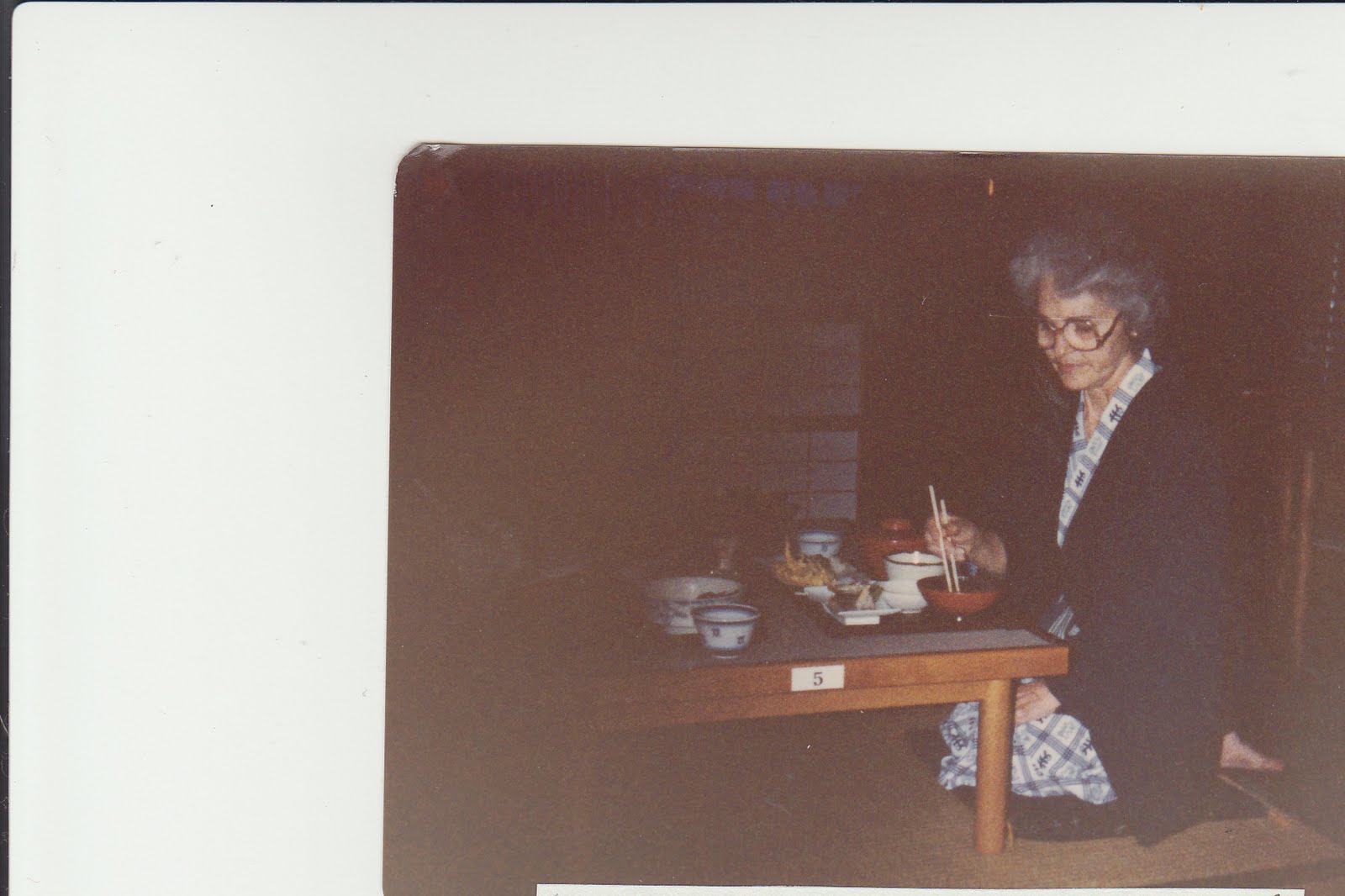 I ate with chopsticks all the time spent in Japan- I got pretty good and even enjoyed most of the food.
Wednesday, May 12, 2010
Traveling in Japan
 Tea Bushes
I learned to like the 'green' tea that the Japanese drink even before it became popular here in the U.S.
 Everywhere we went while traveling in Japan, we saw Cherry Trees and Plum Trees in bloom.
Wilhelmine standing in front of Cherry Tree at Temple.
 More Cherry Trees
 Rice Field
 More rice fields
 More Cherry Trees
 Rice Field
 More rice fields
Rice is a stable food in Japan. Every meal is served with rice.
 Cedar Trees
 Cedar Trees
Friday, May 7, 2010
Plum Festival

 This is 'Saki,' Rice Wine, a very poplular drink at Festivals and gatherings.
 Plum orchard contains many varieties and a wide range of colors.I think the plum blossoms are just as pretty as the cherry blossoms. I brought home a silk screen of plum blossoms painted by a local artist which hangs on the wall in our apartment.
 The Zuishin-in Temple is an Imperial Temple in southwestern Yamashina. The Temple holds its 'Hanezu Odori Festival' on March 30th when the Plum Blossoms are in full bloom.
 Japanese Muscians playing at the Plum Blossom Festival.
 Haezu O Dori is a sacred dance which has been passed on in the Yamashina district. It depicts comically the love life of Onono-Komachi, a poetress, who was extremely popular among the court nobles for her beauty & intelligence.
 I thought this young Japanese woman was so pretty, I asked to take her picture. She was at the Festival.
 The dress in Japan was about 50/50 % when I was there - as you can see here with the Japanese girl in cultural dress and the boy in western wear.
Wednesday, May 5, 2010
Temples
 Japanese women resting inside the Zuishin-in Temple
Many of the older Japanese still dress in traditional kimonas. In Tyoko and the bigger cities the people dress more Western.
 Zuishin-in Temple -This temple is a Shingon Buddhist Sect headquarter.
 Purification rites is required before entering the temples.
 Keyomizu - Dera Temple - Built on stilts
 Japanese write prayers on wood and hang here. The Temple Priest collect and pray.
 Golden Pavillon -Kinkaky-Ji Temple
 The Japanese get special merit for visiting all the temples . When school is out, the children visit the temples the same as our children visit our museums
Subscribe to:
Posts (Atom)